



Anyone interested in wine storage or wine fridges soon faces the same core question: is the cabinet primarily meant for ageing and storing wine — or for bringing it to serving temperature? This guide walks through every relevant decision point, from the right temperature to humidity, right through to aesthetics and everyday convenience.
- 1. Introduction
- 2. Which wine cooler should you buy? 7-point checklist
- 3. What are the correct temperatures for my wine?
- 4. Can I store wine and keep it ready to drink at the same time?
- 5. Why is humidity important for wine?
- 6. Heating — what for?
- 7. How do the wine cabinet cooling systems on the market differ?
- 8. Noise levels
- 9. Energy efficiency
- 10. Aesthetics
- 11. Everyday convenience
1. Introduction
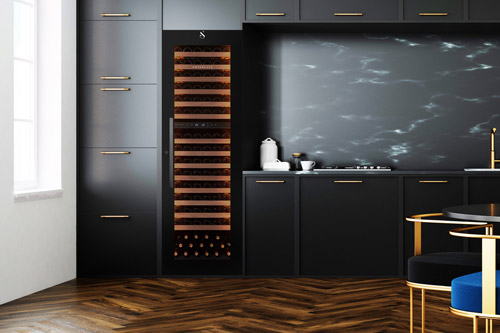
The fundamental question before every purchase
Storing and ageing wine?
Or bringing it to serving temperature?
The answer determines what temperature your wines should be kept at, and which type of unit best suits your needs. The answer can also be "both" — we cover that in section 4.
Sparkling, white or red — wine is kept at one fixed temperature, which calls for a single-zone wine cooler.
For wine that will be enjoyed soon, whites and reds are kept at different temperatures — which calls for a 2-zone serving cabinet.
2. Buying a wine cooler — but which one?
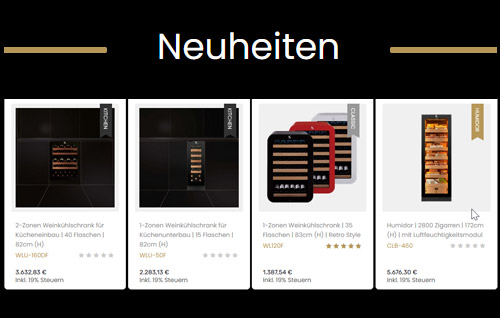
The first question is what you actually need. The 7-point checklist below quickly helps narrow down which size and features are the right fit.
- 1. What do you drink? Red? White? Sparkling?
- 2. Do you want to age wine, serve it at drinking temperature, or both? This determines whether a single-zone or multi-zone cabinet is the better fit for you.
- 3. Where will the wine cooler be placed? In the living room, in the kitchen for the best presentation, or in the utility room or cellar for pure storage? This decides whether a wine cabinet with aesthetic features such as ambient lighting and diagonal presentation shelves makes sense, or whether a more simply equipped model will do.
- 4. How many bottles do you have, or plan to store? This determines the unit size and overall capacity.
- 5. What bottle formats do you have? (Burgundy, Bordeaux, Riesling, sparkling) — a wide mix of formats needs more space. Smaller units in particular are often limited when it comes to oversized bottles.
- 6. What handling do you prefer? Stacking bottles for longer storage, having every bottle immediately accessible, or bottle presentation with diagonal display shelves?
- 7. What's your budget? It determines the unit size, and whether a premium model or a more economical model is the right fit.
Once you're clear on your own needs, the next question is which brand is the right fit. The home appliance market — and with it the wine cooler segment — is increasingly splitting into two camps: a large, confusing segment of cheaply produced mass-market goods built for a 2–5 year lifespan, and a much smaller segment of premium products, where careful selection of high-quality components and rigorous quality management deliver both a premium look and feel and a lifespan of 10+ years.
SWISSCAVE belongs to this small circle of manufacturers, distinguished in particular by interiors developed with wine experts and by optimized temperature and humidity monitoring. A broad range of models for virtually every use case can be found in the SWISSCAVE online shop as well as in the SWISSCAVE showroom.
Other important considerations
- Temperature accuracy (requires intelligent temperature and airflow management plus inverter compressor technology)
- Active humidity control — important for anyone ageing wine for a year or longer
- Durability, thanks to especially high-quality electrical, cooling and mechanical components
- Bottle capacity relative to interior volume — some large coolers hold only 100 bottles in real-world use, others 150 or more
- A well-designed shelving system that accommodates all bottle types and uses the space efficiently
- Noise level under 40 dB
- Aesthetic considerations
- Effective protection against radiation exposure
3. What are the correct temperatures for my wine?
A great deal is said and written about the "correct" drinking temperature. What consistently stands out: red wine is very often served too warm (room temperature) — which only underlines every unwanted nuance and every flaw in the wine. White wine, meanwhile, is often served far too cold (straight from the fridge) — which strips away all its aroma and flavor detail.
Rule of thumb for anything meant to be stored and matured — red, white and sparkling alike. Target setting roughly 12 °C.
Depending on alcohol content and ageing. Red wine should be served cool, never at room temperature.
Noticeably cooler than red — but not straight from the fridge, or the flavor can't fully unfold.
Keep in mind: wine keeps warming up in the glass at room temperature, so it should be held slightly cooler in the wine cabinet than the intended serving temperature. Serving-ready settings: red wine roughly 16 °C, white wine roughly 8 °C.
4. Can I store wine and keep it ready to drink at the same time?
With several wine coolers, this is easy to achieve. But what if you only have one unit? There are, in fact, several approaches that get you close to the ideal scenario — ageing AND serving temperature — in a single wine cooler.
1. Mostly red wine, less white
A two-zone wine cooler: a cool zone for ageing, a warmer zone for serving temperature.
Upper zone: 16 °C — ideal for bringing red wine to serving temperature.
Lower zone: 10 °C — cool, but still within the ideal ageing range for all wines;
white wines are already at serving temperature here.
If a light white or a sparkling wine needs to be a little cooler, a bottle gel sleeve (roughly CHF/€25) kept in the freezer and slipped over the bottle when needed is the fastest way to drop several degrees within minutes.
2. Mostly white wine, less red
Also a two-zone wine cooler, but this time the cool zone is for serving temperature and the warmer
zone is for ageing.
Upper zone: 14 °C — still within the ideal ageing range, with red wine already a
little closer to serving temperature.
Lower zone: 8 °C — ideal for white wine and sparkling at serving temperature.
Take red wine out roughly 20 minutes beforehand and open it, so it can warm up the remaining 2–3 degrees — a welcome side effect, since almost all reds benefit from a little oxygen contact before drinking. If you're short on time, pour into large glasses or decant and wait about 10 minutes.
3. Focused mainly on ageing
A single-zone cabinet is the right choice here. All wines age at 10–14 °C. If you take out white wine more often, set the temperature closer to 10 °C; if you're more focused on red, set it closer to 14 °C.
4. Separate units for ageing and serving
Use more than one wine cooler: a storage cabinet, for example in the cellar, at 12 °C, plus a 2-zone serving cabinet in the living room or kitchen set to 8 °C for white and 16 °C for red.
With any of these four approaches, all your wines stay at the perfect storage temperature — and you can still enjoy your favorite wine at exactly the right serving temperature whenever you like.
5. Why is humidity important for wine?
Ideal conditions
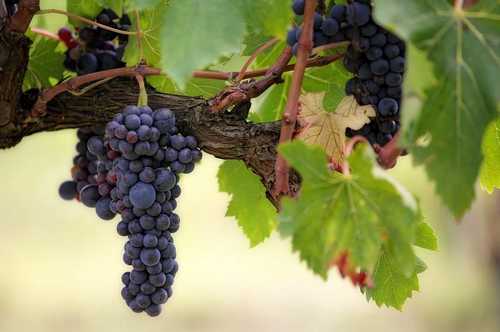
In the cellars and storage vaults of many producers, barrels and bottles sit in damp to dripping wet vaults, cellars or caves — the air there often reaches 80% humidity or more, at a constantly cool temperature. Adequate humidity is essential in particular for the cork.
When the air gets too dry
If the air around the bottles stays too dry for weeks or months (below roughly 50%), corks can dry out — letting oxygen into the bottle. Once that happens, the wine spoils quickly through oxidation. This is also why bottles are stored lying down: it keeps the inside of the cork moist with wine and keeps the seal tight.
Active or passive humidification?
In standard wine coolers, humidity is regulated passively: the condensation created by cooling is used to reach the desired humidity level (50% or higher). This works reasonably well under normal room conditions (roughly 20 °C, 50% humidity) — but reaches its limits in the following scenarios:
- Scenario 1 — dry room air: Normal room temperature (roughly 20 °C or higher), but dry air below roughly 45% over several months — common during winter.
- Scenario 2 — cool rooms: Room temperature only around 12–16 °C, with room humidity staying below 50–55% relative humidity for extended periods.
- Scenario 3 — cold rooms: Room stays below roughly 10–12 °C for extended periods, so the built-in heater kicks in and dries out the interior even further.
SWISSCAVE actively controlled humidification
In all these cases, passive humidification through condensation is no longer sufficient — passive systems simply aren't reliable enough for serious wine ageing. That's why SWISSCAVE developed a unique, actively controlled humidification system that reliably brings the interior to the desired humidity level.
An actively controlled humidification system includes:
- Electronically controlled humidity regulation
- Evaporator module
- Heating module
- Water tank
The intelligent control system uses sensors to ensure distilled or equivalent water is added regularly whenever the air gets too dry. Recommended target: 60–65% — a setting that's too high can cause labels to wrinkle or encourage mold growth. Once room humidity stays above roughly 55%, active humidification can simply be switched off.
The simple rule: if the air becomes too dry for people to breathe comfortably, the corks are drying out too — and the wine is at risk. Under normal living conditions (humidity above roughly 50%, room temperature 20 °C or higher), passive humidification in a cool wine cabinet is usually sufficient.
6. Heating — what for?
Most standard products have, at best, a weak heating coil that can raise the temperature by only 2–3 degrees — usually just enough for two-zone units to achieve any temperature spread between the zones at all (an outdated, inefficient method).
The SWISSCAVE approach
SWISSCAVE uses stronger heating elements — even in single-zone units — that kick in specifically when the interior temperature needs raising in cold environments (a cold cellar, garage, etc.). This heating can raise the temperature by up to 10 °C. As a result, SWISSCAVE wine coolers can be used in environments down to 0 °C, ensuring the optimal storage temperature is always reached.
7. How do the wine cabinet cooling systems on the market differ?
Different systems are used to cool white and red wine in two zones set to different temperatures. Still widespread on the market is a method developed in the 1970s, where the cold zone sits at the top and fans push cool air, as needed, into the warmer zone below. Temperature values can be set reasonably stably with this system, provided they're not too far apart and the ambient temperature is around 20 °C — but at the cost of higher energy consumption, since heating energy is needed to achieve the usual temperature spread. And as soon as the ambient temperature moves away from that 20 °C average, interior temperatures shift too, often ending up several degrees off the target.
Conventional system
Cold zone on top, fans push air into the warmer zone. Higher energy consumption due to the need for heating, and sensitive to deviations in ambient temperature.
SWISSCAVE 2-zone system
More energy efficient, since no heating is needed to reach target temperatures. High temperature stability through intelligent airflow and frequency-controlled compressors, with barely any temperature variation within a zone.
Two systems are used here:
- Two fully separate cooling zones, each independently adjustable to its own temperature range.
- Cold zone and air circulation located in the lower cooling compartment and rear wall — combined with frequency-controlled compressors, this achieves very precise, energy-efficient temperature control in both zones.
8. Noise levels

The three main sources of noise in a wine cabinet are:
- Compressor
- Fans
- Refrigerant noise
High-quality, quiet fans and a frequency-controlled inverter compressor — which adjusts its speed to actual demand and therefore runs at low output most of the time — are essential for noise levels under 40 dB. Piping routed to match the refrigerant's flow pattern prevents unwanted rushing or dripping sounds. Other key elements include well-sealed, wide door gaskets and sound-dampening materials placed where noise-generating components resonate.
Through consistent application of all these measures and first-class components, well below the industry average — and it stays at that level even after years of operation.
9. Energy efficiency
Energy consumption matters increasingly for wine cabinets too. The following factors help keep power draw low:
- Seamless, continuous insulation
- Multi-pane glass door
- Low-energy glass
- Gas fill between the panes
- Frequency-controlled compressor
- Low-energy fans
Energy labels
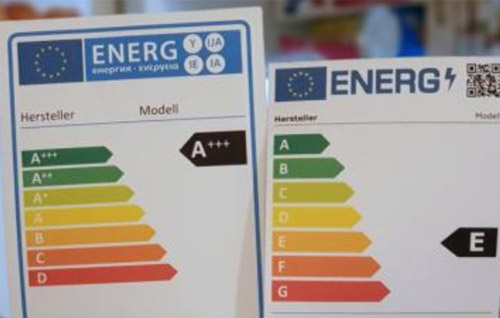
Wine coolers, too, must display their energy efficiency on a dedicated label. Energy classes used to range from A+++ to D. EU regulators have replaced this with an entirely new A–G scale, mandatory for all manufacturers since spring 2021.
Even the consumption figures for the exact same unit look different on the new label, since the new regulation also tightened the measurement criteria. A unit previously listed at 120 kWh now has to be listed at roughly 180 kWh. A unit that used to carry an A+++ rating often reaches only class D or E under the new scale — a former Class A unit can end up rated F or G.
10. Aesthetics
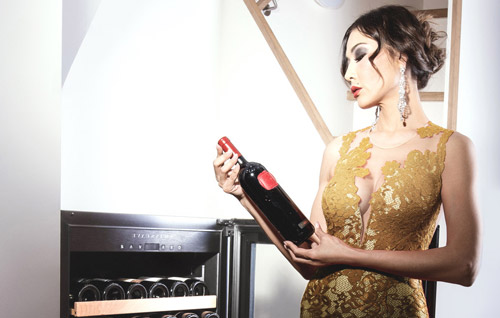
The wine cooler has long since moved out of the cellar and utility room, and is now a welcome, meaningful piece of furniture in the living space of the discerning wine lover. Here too, there are significant differences in material choice, build quality, and how a unit is presented.
SWISSCAVE favors clean, purist design with particular attention to material choice: glass, stainless steel, wood — with a consistent absence of the plastic trims and handles otherwise found everywhere. Lighting is built into the interior walls and creates a clear accent by brightly illuminating every shelf level; the light color can be switched, blending seamlessly into any interior. The housing and door are finished precisely and completely seamlessly, the hinges sit hidden and flush, and the base of the unit is level with the door front.
11. Everyday convenience
The current model range is fitted throughout with smooth-running full-extension shelves. These pull out far enough that even bottles at the back are directly accessible, without needing to lift the ones in front first. The available presentation shelves are multifunctional as standard: usable as flat pull-outs, or — with a simple flip of the support bracket — as angled presentation shelves.
As soon as the glass door opens, the light gradually comes on until the entire cabinet is brightly lit on every level. The light can also be switched to stay on permanently at the press of a button. An alarm alerts you if the door has been left open too long or wasn't closed properly.
Find the right wine cooler
From compact built-in solutions to large-format wine cabinets for serious collections — SWISSCAVE develops wine cabinets for controlled, reliable and stylish wine storage.
Discover SWISSCAVE wine cabinets